Tuesday, 10 May 2011

Culture Week 4

CULTURE                                                                         WEEK 4

I worked for PTCL (Pakistan Telecommunication Company) in customer care office as it was always flooded with loads of people with the small issues that they were going through. As my job was temporary so they always gave me to do job on different timings so that let me meet many people within the organisation. This let me think of many good aspects of working in that organisation as I saw every worker was happy with the job and the company policies. The very few visible aspects of culture I saw were:
The workers were highly motivated by the owner and owners had developed  a sense of belonging amongst the members of the workforce. And the employees had a feeling that they were integral part of the company and the contribution towards company growth was deeply valued by the owner.
The second visible aspect was the respect for each other’s culture and moral values. In other words the company had great respect for the ethics as they are very important part of a company. Ethics can be defined as a system of morals or rules of behaviour. These are the values and beliefs which influence how individuals, group and societies behave.
The next aspect was the feedback given by the customer. As there was a complaint box as well as a suggestion box for the customer and that box was opened by the manager and he used to give feedback to all the employees in order to maintain the standards of the company to the demands of the customers. Regular feedback was a best part of the company that I felt was the most helping. Job enrichment was also a visible aspect but was rarely seen in case of extra ordinary work and loyalty to the company.
 

HANDY:
The British management writer, Charles Handy, classified organisational culture by the power of individuals' roles and functions within an organisation. Handy's four cultures follow.
Power Culture is a situation in which a person is centre of attention or he is such a powerful personality who controls and coordinates everything on his own with no instructions. Individuals generate power cultures when they attract those who have faith in them but the main problem lies when the size of organisation grows and diversifies as it becomes difficult for the individual to sustain that high level of influence. The best example is of this is our politicians. They are the centre of attention of the people and their influence can be seen on everyone as they become ideal for most of people. People try to copy them or else follow them and their rules of life.
Role Culture are found in case of organisations which are huge in size where everyone has to follow the rules and regulations of the company and they can’t do anything with their own choice as they do not have the authority to do so. In this only the person who has authority to do anything can change or fix things otherwise ever member has to do what he/she is employed for. This can be seen in case of educational institutions in which everyone has to follow the rules and there is no one who can change the rules as management is the highest authority to make any leniency for anyone in case of any mishaps.
Task Culture is when the ultimate priority is to complete all the tasks before the deadline as it is job oriented. People have freedom as no rules are set so this gives an advantage to the people to complete in their own way so that they can bring out their best. This can be seen in case of group assignments in universities as the group is given a task to find and deliver the correct information on a topic before the deadlines. All students in a group share the work of assignment and they interrelate it with other work by just communicating that what ideas that are putting in the task given.
Person Culture sometimes also classified as People Culture exists for the people in it, which means a group of people with common interests join hands to start an organisation.  The example of this is the guys who made Facebook. They had common interest that they should create something in which they can contact each other with no barriers but they never knew that it will prove to be such a big success.
After a brief look over this wide topic ‘’Culture’’ I think it is impossible to classify culture in one of the four types. Every type of culture reflects a different situation and cannot interrelate it to the other. Culture depends on different situations, like if like people are working in an organisation there won’t be any unique or new ideas brought in as they are like-minded people and so if u see other culture like in power culture just one person is the centre of attention so till how long he would carry on and till how long people will follow him but at last people will get fed-up as the organisation size will grow.
‘’Introduction To Organisational Behaviour’’ by Richard Pettinger published

Conclusion:
           In conclusion I would say that there are many advantages as well as problems as these cultures do not exactly fit in large organisations and in case of mergers or takeovers as they might have different culture so an Organisation must use different policies in different parts of the world as there are different demands. A company must have respect for the ethical related issues as they might cause problems for a worker, owner, customer and the company. But I have learnt a lot from this topic as it has told me how different organisations operate and how individuals are different from each other.

References:
‘’Introduction To Organisational Behaviour’’ by Richard Pettinger published in 1996 (Macmillan press LTD) Page no. 402-404
http://www.newzealand.com/travel/about-nz/culture/culture-home.cfm  Accessed on 17-04-2011
http://www.ptcl.com.pk/pd_category.php?pd_id=5   Accessed on 17-04-2011

Improving Staff Performance Week 3

IMPROVING STAFF PERFORMANCE                         WEEK 3


The word motivation is coined from the Latin word "movere", which means to move. Motivation is defined as the process that initiates, guides and maintains goal-oriented behaviours. Motivation is what causes us to act, whether it is getting a glass of water to reduce thirst or reading a book to gain knowledge. It involves the biological, emotional, social and cognitive forces that activate behaviour. In everyday usage the term motivation is frequently used to describe why a person does something. A number of social scientists have expressed their views and wrote theories regarding the importance of having a motivated workforce. Further those theories are divided into two categories, Content theories and Process theories.


The content theory of motivation mainly focuses on the internal factors that energize and direct human behaviour. Maslow's hierarchy of needs, Alderfer's ERG theory, Herzberg’s motivator-hygiene theory (Herzberg’s dual factors theory), and McClelland's learned needs or three-need theory are some of the major content theories.
Another type of motivation theory is process theory. Process theories of motivation provide an opportunity to understand thought processes that influence behaviour. The major process theories of motivation include Adams' equity theory, Vroom's expectancy theory, goal-setting theory, and reinforcement theory.
‘’Introduction to Organisational Behaviour’’ by Richard Pettinger

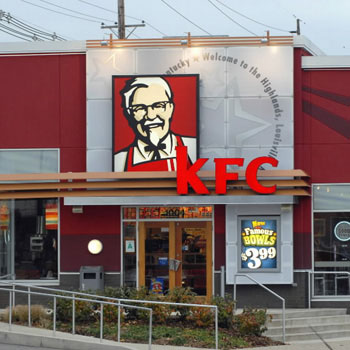
I worked in KFC for a few months and noticed that KFC deals in many ways to motivate their workers as they are famous for their team work approach as they believe that a goal oriented approach, diversity, feedback to workers and a little competition between employees is the best and far most the ultimate way to motivate workers. Not just this there are other motivating factors as well. The different ways in which KFC employees are motivated:


Team Work: it is an established fact that workers perform their duties more effectively if they were given a chance to operate in form of groups or teams. They can work as a cohesive unit and pursue mutual goals successfully. Moreover, this practice makes work enjoyable and less monotonous.  Team work is the most important point that leads towards success. We all used to work as a team as we all knew that how much our contribution is important to the success of the business and to deliver best results. Working together as one team we built a partnership and trust amongst the employees which resulted in improved performance and respect for each other.
Bonus: I think this is the one of the best motivators for employees because the bonus acts as a reward for their extreme hard work. This bonus makes everyone work hard and keep the restaurant up to the standards that company had set for themselves which include good quality service, good quality food and good quality environment for the customers as well as the employees. Bonus is also given to the employees of the whole branch if the restaurant meets all the standards set by the company which are usually checked by unannounced visits or by mystery customers.      
Promotion:  it refers to an attempt to increase the scope of a job by broadening or deepening the tasks undertaken. It is when an employees is given more authority and employee is supposed to carry out more work of similar nature but this time employee enjoys a sense of achievement and job satisfaction as he is more authoritative. For instance in KFC a team member is made a team leader if he is working very well from a long time n a team member is made an assistant manager so this chain of giving more authority motivates the employees.              
Daily benefits: this includes a free meal every full shift a member has done. This is a motivator as it shows the employees how much they mean to the country and apart from this also acts as a reward for the day to day hard work the employees are putting into the business. Apart from this a 20min break is also given to the employees as they get tired working constantly in the restaurant serving loads n loads of customers.

The process theory that relates to KFC is Vroom Expectancy Theory. This theory tells that people will be motivated to do things to reach a goal if they believe in the worth of that goal and if they can see what they do, will help them achieve it. In other words, Victor Vroom believed that an individual’s motivation towards doing anything will be determined by the value he places on the outcomes of his effort, multiplied by the confidence he has that his effort will materially aid in achieving a goal. This may be described as:

FORCE= VALENCE × EXPECTANCY

Where, Force is the strength of a person’s motivation, in KFC the greed to employees to get promotion or bonus is an inner motivation that helps them to work hard. Valence is the strength of an individual’s preference for an outcome as the outcome at KFC is promotion and bonus. Expectancy is the probability that a particular action will lead to a desired outcome. The desired outcome can be anything like for someone it can be experience working for a multinational company or for some people who want to work forever it can be promotion and for people who work part-time or who are students their desired outcome will be bonus.

Conclusion:
Motivation is the driving force that enables a worker to perform at his best level. A business should have a well-motivated workforce if it wishes to achieve its objectives such as productivity, minimising wastage, enhancing efficiency, maximising profit etc.. KFC and other big organisations have enhanced their company’s image a lot with the help of their employees only by motivating its staff to bring out the best out of them so that they deliver the best to the people. Apart from this topic clearly tells and explains how the organisations are also benefiting by motivating its employees.

References:      
http://redriverpak.files.wordpress.com/2011/01/motivation1.jpg   Accessed on 8-04-2011
‘’Introduction to Organisational Behaviour’’ by Richard Pettinger published in 1996 (Macmillan press LTD). Page no 94-133.
http://careers.kfc.co.uk/ (Accessed on 10 april 2011)

Sunday, 23 January 2011

Enterprise week Week 8

Enterprise week             week 8

I attended a few lecture in enterprise week but amongst all of them I just found the most interesting one is ‘’It doesn’t matter if you’re black or you’re white (Michael Jackson)’’.


This event was held at Bucks New University in the North wing building in room N4.06 at 12:00pm. This event was carried out by Arrol Toplin who Is a solicitor and a Law teacher at Bucks New University and the second lecturer was Seth Gyekye who is also tutor for psychology at Bucks. This event went for an hour with its objective of telling that how important diversity is to an organisation and in how many ways it useful.


It was started by Arrol Toplin who laid great emphasis on advantages and disadvantages of diversity. Arrol told the audience how diversity increases the range of skills and vision. E.g have different perspective of looking into the given situation. Diversity is an involvement with the wider community and a better understanding of society. Furthermore he told how top 10 law firms are working together to retain on the top. At the end Arrol told about the countries that refuse to agree with diversity which include South Africa, Northern Ireland pre and post 1969 and Zimbabwe that how racist they are towards white. Later Gyekye took over the lecture stating many different definitions of diversity. Including which were:  Diversity can be differences in race, heritage, customs, belief systems, physical appearance, mental capabilities, etc.
Diversity means differences such as different religious beliefs, different cultural traditions, music, art, dancing etc
Diversity means, in the context of society, having a mixed community of people from all walks of life. When people talk about diversity and having a diverse community, they generally mean that they want to see all minority groups represented in that community.
Audience was informed that diversity is a challenging of meeting the needs of a culturally diverse workforce and Gyekye even said that diversity is almost as diverse as the subject itself. Gyekye further linked many advantages of diversity that it increases creativity and stronger innovative abilities as well as it also maximises workers’ productivity. Diversity has brought a drastic change in international business adventures due to increase in intercultural competence. At the end he closed up with a few solutions to diversity issues and by the sentence picked from IBM company ‘’None of us is as strong as all of us’’.
I took the benefit of learning the factors of diversity that how it increases productivity and competition amongst employees which is beneficial to the employer as it would increase in rate of generation of new idea’s as different minds have different perspectives so as UK is a country that has mixed population from all over the world but still there are few societies in UK that do not accept others as part of them so diversity is what breaks away all such barriers and makes a step near to success for organisation.

Motivation Week 2

Motivation   Week 2

What is motivation? Motivation is the driving force that a enables a worker to perform at his best level. A business should have a well-motivated workforce if it wishes to achieve its objectives such as raising productivity, minimising wastage, enhancing efficiency, maximising profit, enhancing the company’s image etc…


                                                             http://johnsedu.wordpress.com/


A number of social scientists have expressed their views regarding the importance of having a motivated workforce. The following theories highlight this aspect of business effectively.
Abraham Maslow’s “hierarchy of needs”
Fredrick Taylor’s “scientific management theory”
McGregor’s theory “X & Y”
Fredrick Herzberg’s two factor or hygiene theory
and more…..
“Business studies” by Jewell

The most relevant theory to my situation is David McClelland’s theory of needs.  His ideas have since been widely adopted in many organizations, and relate closely to the theory of Frederick Herzberg.
David McClelland has contributed to the understanding of motivation by identifying three types of basic motivation needs.

 These three types are:
Need for Power:
      McClelland suggests that people with a high need for power have a great concern with exercising influence and control. Such individuals generally are seeking positions of leadership. They are frequently good conversationalist, though often argumentative; they are usually forceful, outspoken and demanding and enjoy teaching and public speaking.
Need for Affiliation:
       People with a high need for affiliation derive pleasure from being loved and tend to avoid the pain of being rejected by a social group. As individuals, they are likely to be concerned with maintaining pleasant social relationships, to enjoy a sense of intimacy and understanding, to be ready to console and help others in trouble, and to enjoy friendly interaction with others.
Need for Achievement:
      People with a high need for achievement have an intense desire for success and an equally intense fear of failure. They want to be challenged, and they set moderately difficult goals for themselves. They take a realistic approach to risk and prefer to analyse and assess problems, assume personal responsibility for getting a job done, and like specific and prompt feedback on how they are doing. They tend to be restless, like to work long hours and would rather run their own show.
“Management” by Bartol and Tein
De-Motivation
I always had an interest in studying business but my family never wanted me to do so as I was born in a era when there was a trend or a psychological impact on the minds of people in my country that you are only successful if you are a doctor or an engineer but I never had an interest in that and so my parents forced me to have science subjects in GCSE O-levels so that I could be one of those so called well educated people that was the time when I got demotivated and so I had no interest in reading all that human body functions that how they work, what each body part has to do, what our bodies need to stay healthy etc etc and honestly speaking i didn’t find it exciting. Later I hardly passed GCSE O-levels as I was badly demotivated because I was not doing what I wanted to do as I had planned so many things for myself.

Motivation
Later I explained my parents the reason for not passing the GCSE O-levels with good grades so I tried to convince them that I had no interest in becoming a doctor or an engineer so I got admission in GCE A-levels with business subjects and that was the time I got motivated as I had the chance to prove myself that I can do it so my affiliation was the only force I trusted to achieve good grades. So I worked really hard in GCE A-levels as I didn’t even knew a single thing about business so I passed out with good grades and proved myself that I could that. Now I’m here in Bucks New University studying in a business degree program is my achievement till yet but still there’s a lot more to go to get what I had thought for myself.
Besides formal education I have also been involved in running my family business of agricultural products and lands. The practical experience and exposure has given me the insight into real practices of business and an entrepreneurial mind-set. Handwork, focus, innovation and creativity are what as a person inspire me to work so these things would help to motivate me in the next two to three years.
Conclusion
In conclusion I would say that McClelland theory fits on me as my need for power is my diligence and the eagerness to work for a well-known multinational company; need for affiliation is that i will be passing out with flying colours and the opportunity to do so would be a great milestone achieved in my endeavours to establish myself in business. Need for achievement is the outcome that I think of is to get a decent paid business related job that will help me to have a good healthy living lifestyle. Apart from this theory the other theory that I think is a bit relevant to me in some cases is Maslow’s hierarchy of needs but McClelland’s theory of needs is the most relevant I found as it covers all the aspects of me and my past life.

References:
“Business studies by Jewell”
“Management by Bartol and Tein”